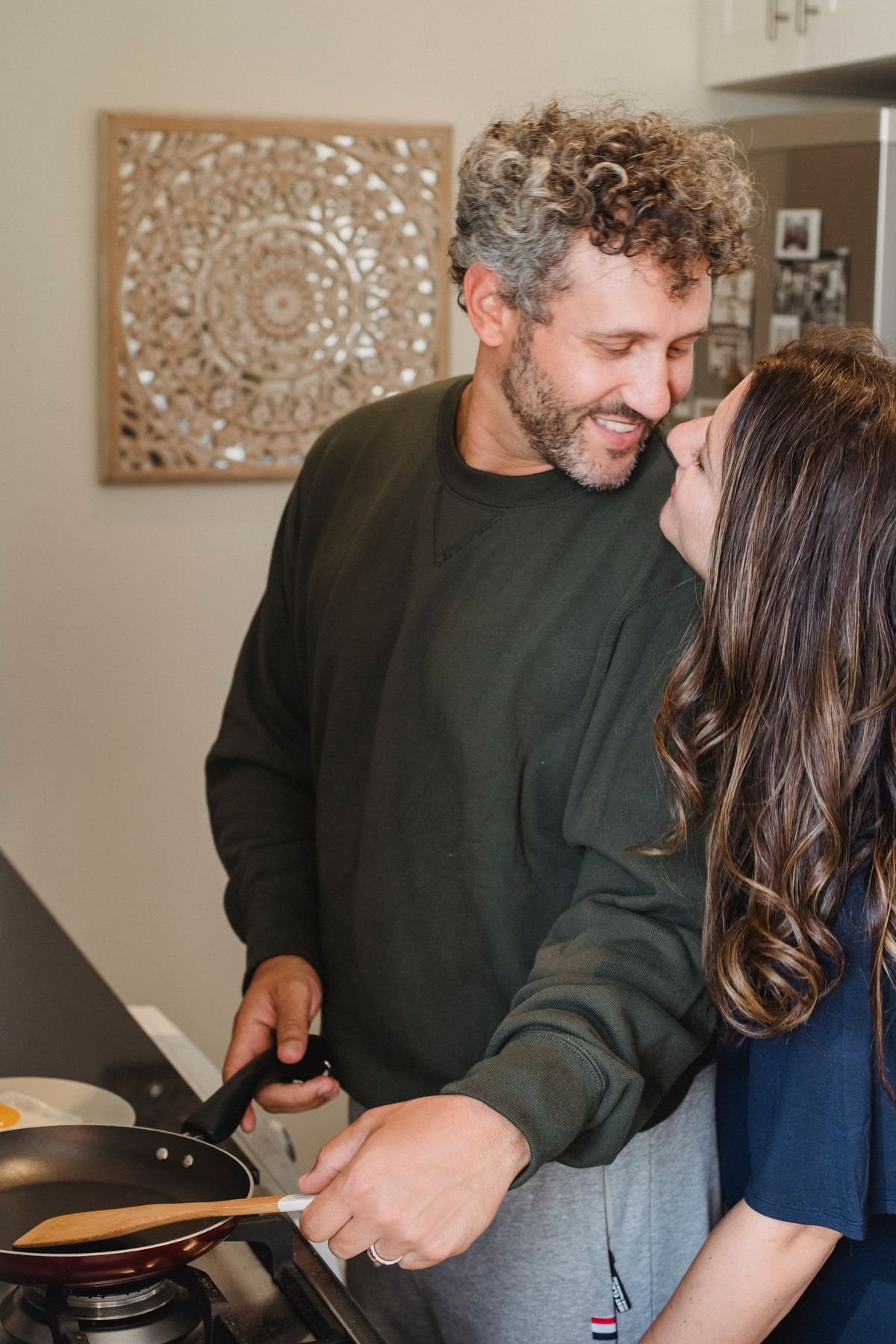
I used to think confidence meant never being nervous around her. I was wrong, and it cost me years. That is how our fifth script in this series opens, and it is the most honest line in it. For a long time I waited to feel confident before I would start a conversation, make a plan, or reach for her hand. The feeling never came first. It never does. If you have been waiting for the same feeling, this article is the way out of the wait.
Here is the truth the script teaches: confidence is not a feeling you wait for. It is proof you collect. Small actions, done while nervous, are the proof. Learning how to be a confident husband is not about changing your personality. It is about stacking small proof, one ordinary day at a time, until your own mind believes what your actions keep showing it.
Below are the five proof-building habits from the script: start embarrassingly small, hold eye contact two seconds longer, say the honest thing once a day, speak a little slower and finish your sentences, and act while the doubt is still there.
☰ Table of Contents Hide
1. Start Embarrassingly Small

The first habit sounds like a joke, and it is the one that makes all the others possible: start embarrassingly small.
Most husbands set the bar where a confident man would set it. A big talk. A grand plan. A perfect evening. Then the bar feels too high, so nothing happens, and another day passes with no proof at all. A small start fixes that. A rep so small you cannot fail it still counts, because your mind does not measure the size of the action. It measures the fact that you moved. One cup of coffee made without being asked. One question asked at breakfast. One plan said out loud instead of kept in your head. Each one is a brick, and bricks are how proof gets built.
Pick one tiny rep. Make her coffee. Ask one real question. Say the plan out loud. Small enough that you cannot talk yourself out of it.
Do it today, not Monday. Proof only collects on the day you act. A plan to start later is the old waiting game wearing new clothes.
Notice that you did it. This part matters. Proof only works if you let it register: you felt nervous, and you acted anyway.
2. Hold Eye Contact Two Seconds Longer

The second habit takes two seconds. When she talks to you, hold her eyes two seconds longer than you usually do before you look away.
Looking away is what nervousness does on its own. Your eyes drop to your phone, the counter, the floor, anywhere that feels safer. She reads that drop every single time, even when she says nothing about it. Holding her gaze a little longer tells her something words cannot: I am here, I am not hiding, and I can stay in this moment with you. It is also proof for you. Two seconds feels long the first day. By the end of the week it feels like nothing, and that change is the sound of confidence being built. Your full attention is one of the things she wants and never asks for, and eye contact is where attention becomes visible.
How to practice the two second rule
3. Say the Honest Thing Once a Day

The third habit is one honest sentence a day. Not a speech. Not a confession that takes an hour. One true thing, said plainly, instead of the easy answer.
Most husbands edit themselves all day long. “I am fine” when he is not. “Whatever you want” when he does have a preference. “Nothing is wrong” when something is. Each edit feels safe, and each one costs him a little of her trust, because she can hear the gap between the words and the man. One honest sentence a day closes that gap. It also builds a kind of proof the other habits cannot: proof that the real you can be in the room and the room stays calm. That is the ground confidence actually stands on.
HONEST LINES THAT COUNT
“I had a hard day. I do not need fixing. I just wanted you to know.”
Three more you can borrow
“I would rather stay in tonight. I am worn out, not bored of you.”
“I do not know how to do this part yet. I am learning.”
“I missed you today. That is all. I just missed you.”
4. Speak a Little Slower, and Finish Your Sentences

The fourth habit lives in your voice. Speak a little slower, and finish your sentences.
Nervous men rush. The words speed up, the voice gets quieter at the end, and the last part of the sentence trails off into nothing, as if the thought was not worth hearing. She hears that trail off, and so do you, and both of you learn the same lesson from it. Slowing down changes the lesson. A man who speaks a little slower sounds like a man who believes his words have weight. And finishing the sentence, all the way to the last word at full volume, is a rep you can do in every single conversation, all day long. No special moment needed. Every finished sentence is proof.
Fast words that trip over each other.
Sentences that fade out at the end.
“Never mind, it is not important.”
A pace she can follow without effort.
The last word as clear as the first.
“Here is what I think. Here is what I need.”
5. Act While the Doubt Is Still There

The fifth habit holds the other four together: stop waiting for the doubt to leave before you act. Act while it is still there.
Start the conversation while your heart is still loud. Make the plan while you are still unsure it is a good one. Reach for her hand while the small voice says she might pull away. This is the whole secret, and it is why the proof idea works: an action done calmly teaches you almost nothing, because calm was never the problem. An action done while nervous rewrites what you believe about yourself. The script ends with the line worth keeping on your fridge: she does not need a man who never doubts. She needs a man who acts kindly and clearly, doubt included. Asking and listening, the fourth moment in our first article, is one of the kindest of those actions, and it is waiting for you tonight.
Name the doubt, quietly. “I am nervous and I am doing it anyway” is a stronger sentence than any pep talk.
Move within ten seconds. Doubt grows in the gap between deciding and doing. A quick start starves it.
Let the result be the teacher. Some tries will land softly. Some will not. Both are proof that you are a man who moves.
Proof Beats Feelings, Every Time
You were never missing confidence. You were missing proof, and proof is something you can start collecting today, before dinner, with a cup of coffee and two extra seconds of eye contact. Start embarrassingly small, act while the doubt is still talking, and let the stack grow. If you want all five habits laid out as a simple daily plan, the free guide on this site, 7 Things She Wishes You Understood, is a kind place to keep going. Save this on Pinterest, so the habits are there on the days the doubt is loud.
Confidence is not a feeling you wait for. It is proof you collect, one small action at a time.
Questions Husbands Ask
How can I be confident with my wife if I still feel nervous?+
You do not wait for the nervous feeling to leave. Confidence is proof you collect, and the proof only counts because you acted while nervous. One small action today is worth more than a month of waiting to feel ready.
What is the smallest first step I can take?+
Smaller than you think. Hold her eyes two seconds longer than usual. Say one honest sentence. Make her a cup of coffee and sit with her while she drinks it. If it feels almost too small to count, it is the right size.
Does being a confident husband mean never showing doubt?+
No. She does not need a man who never doubts. She needs a man who acts kindly and clearly, doubt included. Hiding doubt is acting. Moving kindly with it is confidence.
How long does it take before this feels natural?+
There is no fixed number of days, and anyone who promises one is guessing. What is true is simpler: every rep makes the next one easier, because your mind keeps the proof. Most husbands feel the shift within the first week of daily small reps.
What should I do when I freeze in the moment?+
Shrink the moment. You do not need the perfect words. Slow down, finish one short sentence, and let it be enough. A finished small sentence builds more proof than a big speech you never gave.

Elena Hart
AUTHOR OF ELENA NOTES
Hello, I am Elena Hart. I write short, honest notes about love and marriage, from my side of the table, for husbands, wives and parents who want a warmer home.
I am not a therapist. I write about the small things that make a marriage kinder: being present, listening well, and choosing each other in ordinary moments.